Community Violence Intervention Advocates, Legislators Reimagine Public Safety Policy at Panel Discussions on RIFL Act
Chicago remains on track to record its lowest number of shootings since 1965, but after a year of facing threats to sustainable funding, leaders in the field of Community Violence Intervention (CVI) continue to explore new, innovative ways to save even more lives. The momentum to end gun violence in the state of Illinois continues to build, but the pace must be sustained by effective collaboration across public and private sectors, with all hands on deck, from boots-on-the-ground outreach to advocacy in Springfield.
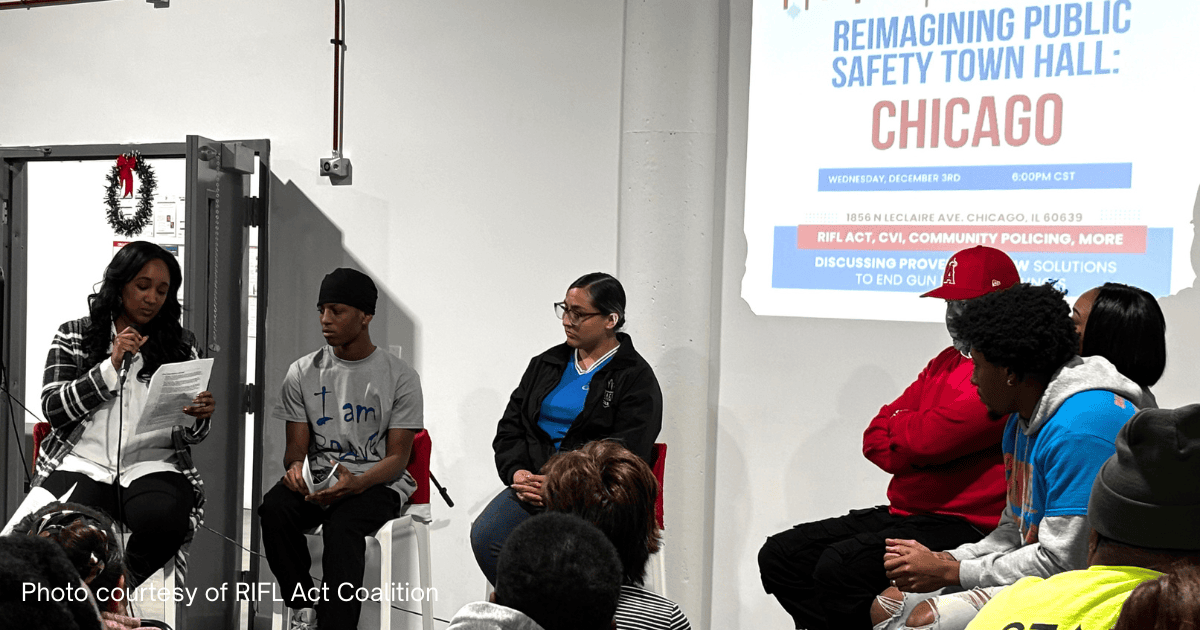
On Wednesday, December 3, 2025, SAFE Illinois and the RIFL Act Coalition hosted a panel discussion at the Institute for Nonviolence Chicago (INVC) to highlight emerging public safety strategies in Chicago and Illinois. A central focus of the conversation was a critical piece of legislation that would require firearm manufacturers to share the public costs of gun violence, costs that currently fall on Illinois taxpayers.
Gun violence imposes more than $18 billion in direct and indirect costs each year; the proposed RIFL (Responsibility in Firearm Legislation) Act would require firearm manufacturers, based on the frequency of their products appearing in crime scenes, to contribute annually to a fund supporting CVI efforts across the state.
If enacted, the RIFL Act could become a cornerstone in ensuring stable, long-term funding for CVI in a critical moment. Moreover, it would require firearm manufacturers hold a direct stake in ensuring fatal shootings are reduced, potentially setting a national precedent and an industry first.
The event was presented in collaboration with Communities Partnering 4 Peace (CP4P) organizations—INVC, the Alliance of Local Service Organizations (ALSO), and Public Equity—and partners including Chicago CRED, One Aim Illinois, the Illinois Alliance to Prevent Gun Violence, the Chicago Police Department (CPD), and others. Throughout the evening, a large group of CVI advocates shared their insights on public safety. Discussions were moderated by youth participant Dahrion Gatewood, INVC Vice President of Development and Communications Shunda Collins, and Chicago CRED Founder Arne Duncan.
Much of the discussion centered around the value of CVI in Chicago’s communities, why long-term funding is so important, and the transformation the CVI ecosystem has undergone over the last ten years.
Teny Gross, founder of INVC, kicked off the conversation by illustrating the level of investment in CVI efforts to ensure people from Chicago’s highest-risk areas with lived experience or criminal backgrounds are transformed into credible messengers of peace. Rather than focus on incarceration as a solution to community violence, with nearly $1 billion in investments over nearly a decade, CVI has shifted the solution from punishment to restorative justice.
“This is no longer just about violence reduction. This is violence reduction and social justice. This is investment in communities that never had it,” shared Gross.
Alesisia Cobb, Senior Director of the Emerging Leaders Network at Cities United, called Chicago a “mecca” for CVI work, and credits this to the impressive level of collaboration and mutuality between direct service providers, advocates, funders, researchers, and others in the CVI ecosystem. The historic decreases in violence in the city of Chicago didn’t happen overnight; the trend is the result of the hard work and dedication of frontline workers, advocates and legislators, and everyone who has contributed to the fight against gun violence.
“In order to push this roadmap to protect CVI legislation and policy, we have to work together. It provides us with all the tools and resources we need to do not just CVI work, but public safety work as a whole,” Cobb said.
An essential tenet of CVI work is that credible messengers have a crucial perspective on how exactly to reduce gun violence in the first place. Alexia Roman, who serves as an outreach worker for ALSO, shared, “Being able to use my life experience and bring the influence that I have in my community is really powerful. Sometimes people ask me if I think [CVI] really works. I say, ‘Look at me. I’m here.’”
Lanetta Turner, Chief of Staff for Cook County Board President Toni Preckwinkle, spoke from the perspective of the public sector, and emphasized the importance of those frontline workers who work overtime as outreach workers, case managers, and victim advocates. “We’re all committed to the same goal of driving down violence and treating that violence as a public health crisis. What has worked is proven strategies around CVI and interrupting violence on the street, and we couldn’t do that without everyone that’s on the front lines doing the necessary hard work. […] We have to keep our foot on the gas.”
Senator Robert Peters added, “We treat [public safety] as rocket science and it’s not. Public safety is actually pretty simple. And the thing is, we’re the richest, most powerful country in the world; the fact that we are [constantly in] an uphill battle in a public safety crisis is an embarrassment. I feel it is our responsibility to change that.”
Dr. Anthony Douglas II, coauthor of the RIFL Act, concluded, “We have to end the profitability of our trauma. And right now, there’s an entity of the industry that is profiting every time their products caused harm in our communities, and so until we tie them financially to what their products do in our communities, this will continue to happen.”
Passing the RIFL Act will require public pressure from supporters of CVI work and sustained momentum to make Illinois a safer state. While the bill currently stands to be approved for voting by Senate President Don Harmon, advocates hope that in the upcoming legislative session, leaders in Springfield will match the urgency and commitment demonstrated by CVI’s frontline workers.