
Sharonda Giles, Director of CP4P’s Crisis Prevention & Response Unit: ‘Women Have the Power to Set the Stage’


Metropolitan Peace Initiatives is proud to celebrate the lives and work of women in Community Violence Intervention (CVI). Read more stories here.
Sharonda Giles, Director of the Crisis Prevention & Response Unit (CPRU) at Metropolitan Peace Initiatives (MPI), doesn’t just manage and operate a unique crisis intervention initiative; Giles is in the field herself, doing the work of monitoring large crowds and responding to critical incidents in real time.
“As a director, if I’m going to have control over this, I want to know what’s happening at the boots-on-the-ground level. I need to know firsthand what it’s looking like,” she says.
She describes being familiar with the realities of violence from an early age, being born and raised in the Back of the Yards neighborhood. Growing up, her passion was performing arts, which she says helped her come out of her comfort zone. “Especially when you come from a neighborhood like that, you stay quiet, you stick to yourself, you fly under the radar as much as possible. That helped me find my voice,” Giles explains.
While away at college in Atlanta in 2011, Giles’s godbrother was tragically killed by gun violence, an experience she describes as “a shock.” The experience steered her back to family, and to the city she wanted to impact the most.
“I just felt like it [was] time for me to come back to Chicago,” she says. “This is my home, this is where I want to work, and I want to do good, specifically, here.”
“I just felt like it [was] time for me to come back to Chicago. This is my home, this is where I want to work, and I want to do good, specifically, here.”
Initially, Giles’ focus was substance abuse counseling, inspired by the experiences of her family, friends, and neighbors who had suffered from addiction. During her time working in a treatment program, Giles lost another loved one to gun violence.
“It’s different when it’s somebody you know. It hits closer to home,” she says.
Further galvanized to make a positive impact, Giles then worked in several roles at different organizations as a mentor for justice-impacted youth. The links between the court system, mental health, violence, the school-to-prison pipeline, and the various other issues her clients and community face began to click into focus. She asked herself, “How do I make it all make sense?”
Her curiosities and expertise culminated when she joined MPI as the Director of CPRU in July 2023. Distinct from Communities Partnering 4 Peace’s (CP4P) street outreach teams, CPRU serves as a mobile unit of violence interrupters deployed during mass shootings and high-volume gatherings.
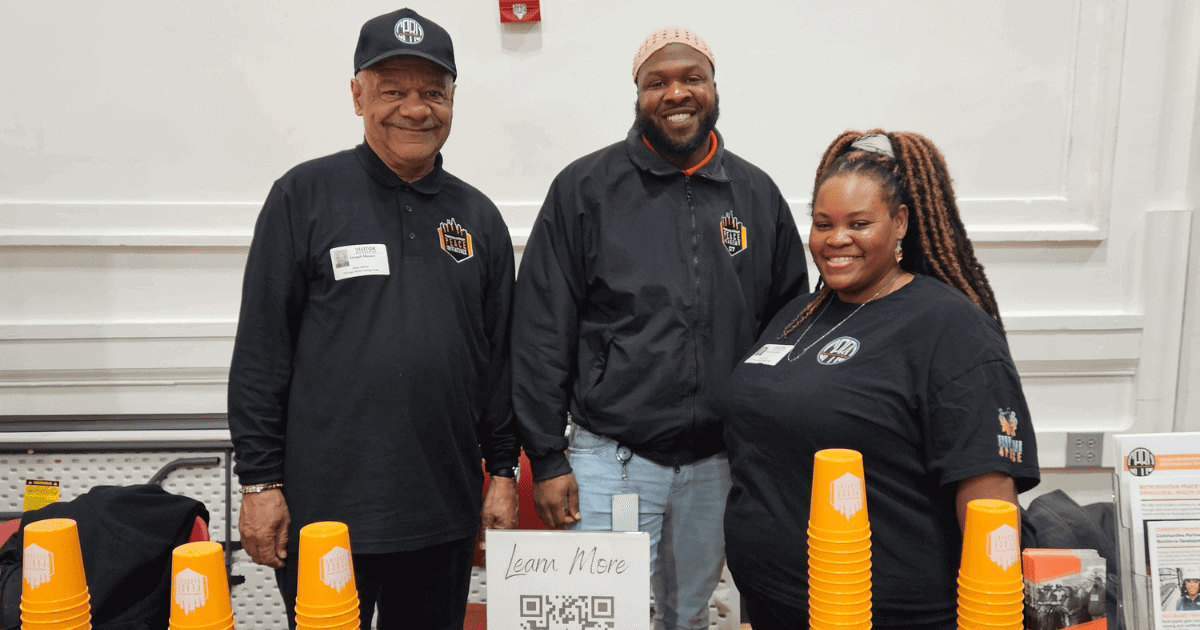
Often, CPRU goes out during “teen trends,” or large crowds of teenagers, usually at beaches, downtown, and throughout Chicago’s neighborhoods. The team monitors the situation to reduce victimizations and arrests, while making themselves and their resources available to the youth.
To the young people especially, CPRU has become a recognizable presence in the city: “They call us the orange people,” Giles says, referencing the bright uniforms they wear on deployment.
Typically, rapid response requires swift judgement, relevant knowledge of available resources, and keen observational skills. As the Director of CPRU, all of Giles’ skills, from performing arts to counseling, come into play on a deployment.
“I have to be able to read people and their emotions and understand where a person is coming from,” she explains.
“I have to be able to read people and their emotions and understand where a person is coming from.”
Relationship building is at the heart of CPRU’s violence prevention strategy. CPRU’s crisis responders make genuine connections with community members and build trust so they can effectively de-escalate potentially violent situations. She explains, “I think that’s what helps a deployment be more successful, the more that these kids, even the adults, trust us.”
Gender can add another nuance to working in the field. As Giles describes, the young people often see the women on the CPRU team as nurturers, creating a calmer environment from the beginning. Giles notes that at least one woman needs to be at every deployment.
“People tend to fear women less and see them as more neutral people,” she explains. “If we’re approaching a group of kids and they see a group of only men, there’s going to be a level of tension. [Rather] if a woman takes the lead, she’s [a maternal] figure. I think women have the power to set the stage.”
But being seen as a maternal figure can also have its drawbacks in the field of Community Violence Intervention (CVI), which is still male-dominated.
“If you’re more emotional, it’s seen as a bad thing, a weakness, as opposed to a human connection. That’s a struggle,” Giles says. “But there are some people who embrace it, who say, I’m emotional, but I’m still great at my job, and it just shows I care. Instead of our emotions being something bad, it becomes something more powerful.”
Giles says the solution to empowering women in CVI is a self-sustaining support system. “There needs to be more networking between the women who are here. Once [Women’s History Month] is over, what’s next? How do we build a community? How do we support each other on a day-to-day basis, not just when it’s time to highlight something?”
“How do we build a community? How do we support each other on a day-to-day basis, not just when it’s time to highlight something?”
Still, with its nuances and challenges, Giles says CVI is an essential part of Chicago’s future. The trauma of violence has become so common it’s the norm in many communities, but Giles says CVI offers a different possibility. CVI services like case management, street outreach, victim advocacy, crisis response, and more are all proven, effective strategies for creating a safer, healed city.
“We don’t want to thrive in trauma,” she says. “This is our norm, but that’s not what it’s supposed to be. We’re working toward healing. That’s why CVI is so important.”
Read more Women in CVI stories here.