Public Equity’s Theodoshia Kilgore Is ‘Doing The Work’ to Help Community Thrive

Community Violence Intervention (CVI) is powered by relationships, and relationships require trust. That principal is a driving force of why CVI is so effective, because it’s sustained by the very people who are from and live in the community. CVI professionals work from lived experience, which gives them the credibility to enact real change and stop violence from happening.
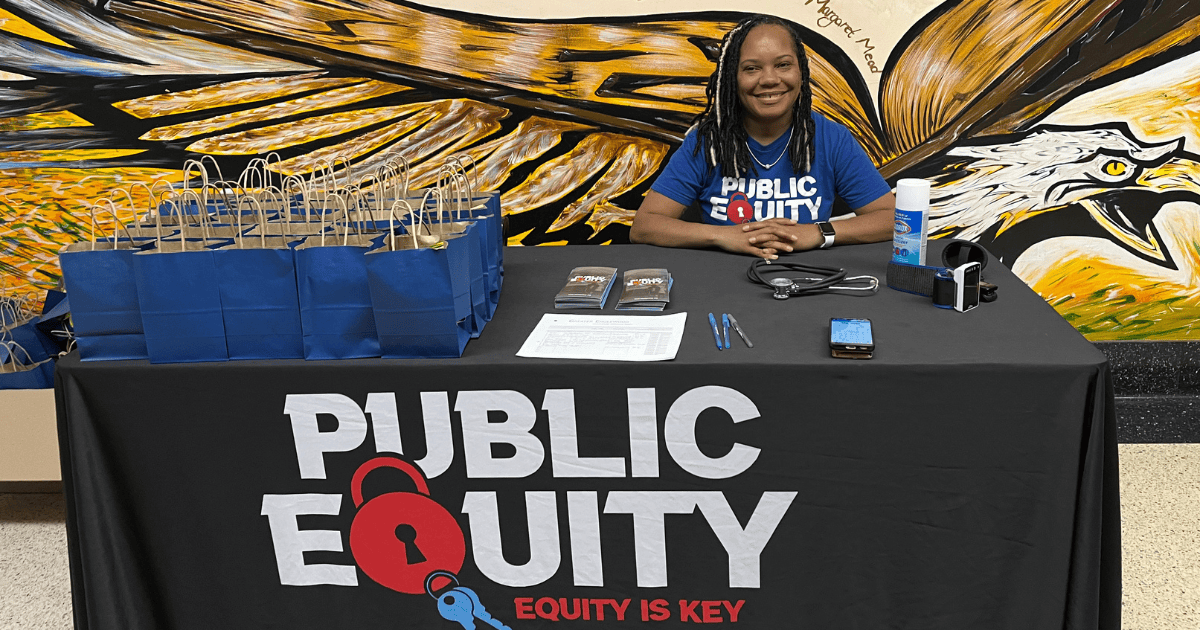
For Theodoshia Kilgore, Case Manager Coordinator at Public Equity in Auburn Gresham and Englewood, her experiences guide her in providing the most effective and empathetic care she can for her participants, who are also her neighbors.
Kilgore grew up in Auburn Gresham, the same neighborhood where she now works to support families and prevent violence. She was raised in a household with eight adopted siblings and three biological siblings, and her biological parents struggled with sobriety. She says she was able to maintain a relationship with them, and they were able to stay sober until their passing earlier this year.
Her lived experience dealing with grief and family trauma also informs her work as she helps her participants navigate some of the same issues. She remembers her brother, who passed away from health problems as a young adult.
“He didn’t pass from gun violence, but he was young, and he was kind of out there in the streets,” Kilgore said. “If he was in the [case management] program, maybe he would have taken care of his health. Where I work, we run a Healthy Habits workshop, where we engaged our participants in discussions about health issues like diabetes, trauma, obesity, and more.”
Before working in CVI, Kilgore spent over 20 years in childcare and wore many hats as a teacher, assistant, lead teacher, health and safety coordinator, and more. However, she said she never knew about case management as it pertains to violence prevention. Looking back, she says her experience working in childcare and with families prepared her for the role.
“I’ve always dealt with parents, so I understood how to build relationships with adults. You have to communicate very well. You have to have difficult conversations,” Kilgore said.
Now, with a bachelor’s degree in applied behavioral studies and training through the Metropolitan Peace Academy, Kilgore works as a Case Manager Coordinator with Public Equity, a member of Communities Partnering 4 Peace (CP4P). She draws strength and perspective from her personal experiences.
With her participants and community members, she drafts linkage agreements, which are individualized plans for accessing services like behavioral health, workforce development, educational advancement, and more. She even helps participants secure important documents like identification, which can unlock many of the other resources she helps connect them to.
“It’s really important to listen,” she explained. She’s not a therapist, but she is an integral part of connecting participants to therapy. And with those participants, she’s honest. “I don’t overpromise. I tell them, I can’t promise you anything, but I can refer you to a lot of things.”
Kilgore also thanks the street outreach team at Public Equity which helps bolster her credibility. “My participants trust me because their outreach workers trust me with them,” she said, noting that those outreach workers, in turn, provide Kilgore with the most accurate information on her participants. This creates a cyclical relationship where the community gets the most effective support possible.
She says timing is especially important in case management. “In those first two or three weeks, we reel them in or we’ve lost them.” But ultimately, even if someone may need assistance, they’re not always ready. Kilgore explains, “The hardest part of my job is when I’m not able to reach the individual, whether it’s because they don’t answer their phone or they don’t follow through with the referrals I send them.”
She continues, “[It’s just that] they’re not ready or they have certain obstacles. […] There’s ways to try to make things better, but ultimately it has to be something they’re really going to do.”
Thanks to the Outreach team, she can get in touch with some of those harder to reach participants who still deserve assistance.
“We have a lot of great success stories, and they’re still coming,” Kilgore said. Her participants often reach out and thank her personally for her work, which she says is very meaningful to her.
From her perspective, she sees women in CVI as especially important when trying to reach female participants. She says that women naturally will listen to each other, helping them to build a strong connection, because women in CVI know what they’ve been through from experience. She says that even if there’s a lot of men doing street outreach work, we shouldn’t ignore the hard work women are contributing to the field.
“They’re having those tough conversations, assessing plans […] building those relationships,” she said.
The work remains crucial, Kilgore says. With the support of Public Equity and her family, she remains dedicated to providing essential services to her neighborhood.
“There’s a need for it in every neighborhood,” Kilgore said. “I see myself growing with Public Equity. I’m definitely doing the work.”
Metropolitan Peace Initiatives is proud to celebrate the life and work of women in Community Violence Intervention (CVI). Read more stories here.