Metropolitan Peace Initiatives Joins South Side Strong Summit

Last week, Metropolitan Peace Initiatives (MPI) joined fellow researchers, and community leaders at the South Side Strong Summit, a one-day convention on University of Chicago’s campus, focused on Community Violence Intervention (CVI) and the shared work of building safer neighborhoods in Chicago.
The day opened with an insightful panel, “Evidence-Based Program Leadership,” moderated by Dr. Franklin Cosey-Gay, Executive Director of Community and External Affairs at UChicago Medicine. MPI’s own Domonique McCord, Chief Program Officer, joined Monica Bhatt of the University of Chicago Crime Lab and Olivia Brown of Project Unloaded for a conversation about what it means to lead with research, humanity, and collaboration.
“When we can take the research and overlay it into participants’ everyday experience… that’s helping to see it clearly,” McCord said. “It is about the human connection and the lived experience. When you center people and their humanity from the beginning, it opens the door to real relationships.”
The conversation centered on the importance of partnership—between institutions and communities, between data and lived experience, and between generations of leaders. “We partnered with organizations,” Bhatt said. “There are lots of individuals in the city of Chicago who could benefit from this program. We need to understand what the impact is.
“We’re reaching teenagers before they’ve made decisions, or while they’re actively making decisions about guns,” stated Brown.
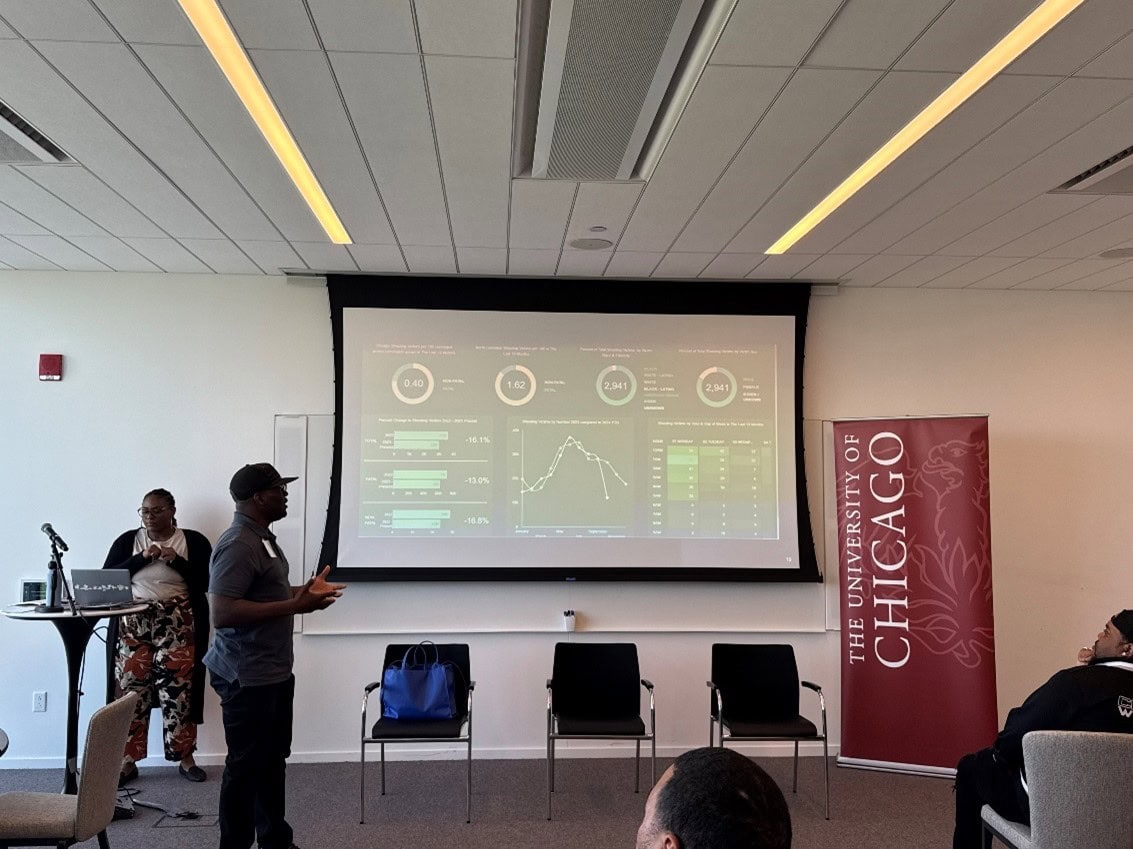
In the afternoon, MPI staff led a breakout session, “A Guide to Building a Data-Driven Culture,” facilitated by Nakiya Walters, MPI Data Analyst, and Steven Perkins, MPI Director of Field Instruction.
“Data always helps us guide and drive the work,” Perkins said opening the afternoon. The session invited participants to think practically and strategically about how to use data to drive meaningful change in CVI.
“What does a strong data infrastructure allow you to do?” Walters asked. “It allows you to define program impact and success.”
She demonstrated how MPI’s violence reduction dashboard can help organizations see neighborhood-level trends, identify urgent needs, and work together across service areas. “What are the hot spots? What’s happening over time? Who’s working where?” Walters said. “This tool helps us ask and answer those questions.”
At the end of the session each participant left with well-structured goals around data for their own community-based organizations.
From the morning panel to breakout rooms to hallway conversations, the South Side Strong Summit served as a reminder: when we come together around evidence, relationships, and shared purpose, our work is stronger.