Governor Pritzker Says State-Funded Peacekeepers Program is Working: ‘Corner by Corner, Block by Block’
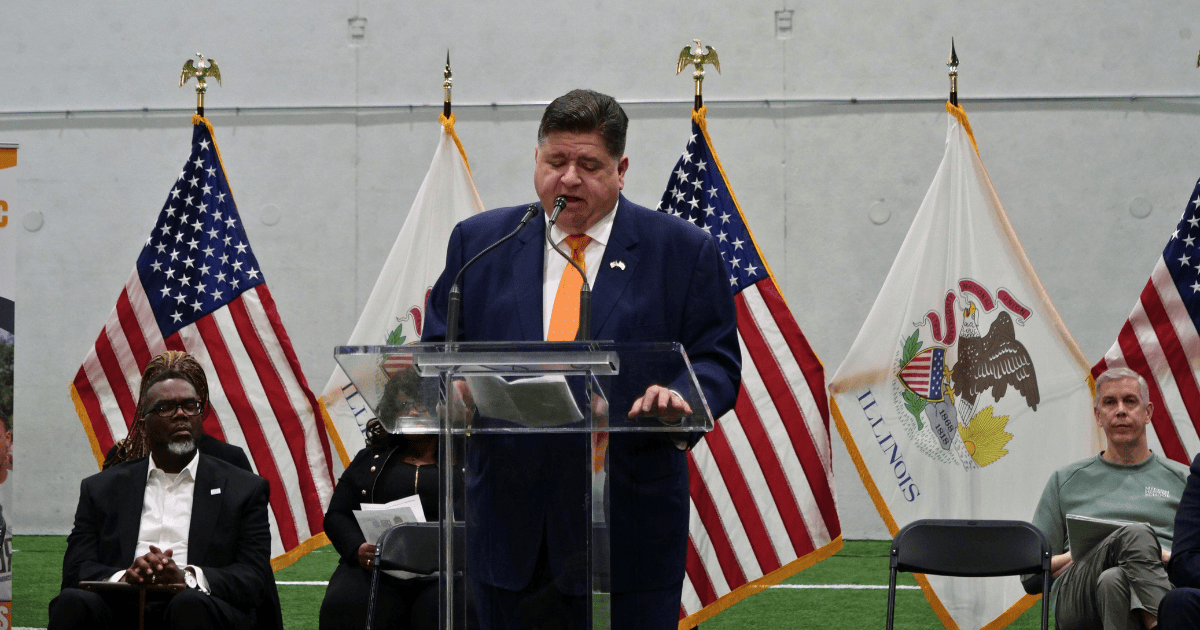
A press conference held on Thursday, April 17, 2025 at the Pullman Community Center welcomed Governor J.B. Pritzker, Mayor Brandon Johnson, state and city elected officials, and over 200 Community Violence Intervention (CVI) professionals across Chicago. The purpose was to celebrate a new report released by the Center for Neighborhood Engaged Research and Science (CORNERS), which details the effectiveness of the state-funded Peacekeepers Program.
The Peacekeepers Program, also known as F.L.I.P. (Flatlining Violence Inspires Peace), is an initiative from various Chicago CVI groups, which include Metropolitan Peace Initiatives (MPI), Communities Partnering 4 Peace (CP4P), Chicago CRED, and Acclivus. Under the program, more than 1,000 individuals at high risk of shooting or being shot are deployed to occupy more than 200 of the most dangerous “hotspots” in the city during periods of high conflict.
Governor Pritzker shared high praises for the Peacekeepers Program.
“Peacekeepers have resolved nearly 1,500 conflicts, many of which would have resulted in violence,” said Governor Pritzker. “Each of those represents a life that could have been taken too soon, a potential that would have gone unfulfilled, and a family that would have been left devastated.
“Corner by corner, block by block, neighborhood by neighborhood, we are freeing our communities from the age-old patterns of crime and violence. That bold and innovative approach has produced truly remarkable results.”
The proof is in the newest CORNERS report, which found that the 27 Chicago neighborhoods and eight suburban communities utilizing the Peacekeepers Program experienced a 31 percent decline in gun violence in 2023 and 2024 compared to the previous two years. Meanwhile, hotspots in the city saw a 41 percent decline in shootings.

Sharonda Giles, Director of the Crisis Prevention Response Unit (CPRU) at MPI, also took to the mic to discuss her team’s success in de-escalating potentially volatile situations.
CPRU is modeled after the Peacekeepers Program, and consists of a mobile team of violence interrupters who collaborate with the Chicago Police Department during mass shootings, civil unrest, and, most frequently, teen takeovers. The ultimate goal is to reduce victimizations and arrests. In the two years of the CPRU’s existence, the team has been deployed over 62 times, with 82 percent of those deployments resulting in zero victimizations and zero arrests.
“We’re a reassuring presence that brings a sense of safety and care to the neighborhoods in distress,” Giles shared. “While the work is extremely dangerous, our team embraces it because they have a heart. We know the community needs to be healed, and we want to promote that peace across Chicago.”
The Peacekeepers Program and CPRU are made possible by vital funding provided by the Illinois Office of Firearm Violence Prevention from the Illinois Department of Human Services. Funding was initially secured during fiscal year 2020 through the Reimagine Public Safety Act (RPSA), a comprehensive, long-term approach to curbing gun violence. Community organizations across Chicago are doing this violence prevention work through youth programming, behavioral health, workforce development, trauma recovery, and other wraparound services.
These CVI efforts are also sustained by the “Scaling Community Violence Intervention for a Safer Chicago” (SC2) initiative, a plan to scale CVI programs in Chicago’s highest-risk neighborhoods.