Back to Our Future 2.0: Metropolitan Peace Initiatives Launches First Youth Initiative

Metropolitan Peace Initiatives (MPI) is expanding its set of wraparound services with the launch of its new Youth Interventions initiative, beginning with the first program: Back to Our Future 2.0 (B2OF 2.0). In collaboration with the Illinois Department of Human Services (IDHS), Chicago Public Schools (CPS), the Mayor’s Office of Community Safety, and select Communities Partnering 4 Peace (CP4P) organizations, the program seeks to engage and support youth ages 14 to 21 who have been disconnected from the educational system and are at risk of being involved in or exposed to gun violence.
Originally funded by IDHS and launched in 2022 with support from CPS, the University of Chicago’s Crime Lab, and several community-based organizations, B2OF 2.0 aims to re-engage youth through intensive programming, while helping them reconnect to educational or career pathways that best suit their needs.
Participants who are referred to the program have been identified as having a history of chronic absenteeism, are justice system-involved, and/or have experienced the effects of violence in their communities. These individuals will be offered support through programming that includes relentless engagement, street outreach, academic support, mental health and cognitive behavioral interventions, mentoring and life coaching, family support, soft skills training, case management, and workforce development.
Full programming—from outreach to reconnection—can last up to one year, but support is tailored to each student’s unique needs.

“This programming is aimed at supporting and catching students who have fallen through the cracks. We want to figure out why and create a pathway to healing and re-engagement,” said Thembi Ndebele, Senior Program Director of Programs at MPI. “We believe the suite of services we will provide will help students see the myriad options available to them and inspire their pursuit.”
MPI Executive Director Vaughn Bryant said he sees B2OF 2.0 as a natural expansion to the organization’s vision for creating a safer Chicago. In the program’s first iteration, the Crime Lab found that more than 90% of school-aged victims of gun violence were not active in school at the time of their victimization.
“To end the cycles of violence, we have to cut off the pipeline and redirect those at risk of being a victim or perpetrator of gun violence,” Bryant said. “With Back to Our Future 2.0, we have the opportunity to connect with youth and their families prior to full adulthood, and offer support to ensure their success.
“Thanks to our partnership with the Illinois Department of Human Services, Chicago Public Schools, the Mayor’s Office, and Communities Partnering 4 Peace, we will continue to build on this citywide effort of providing strategies and solutions to reducing gun violence across the city.”
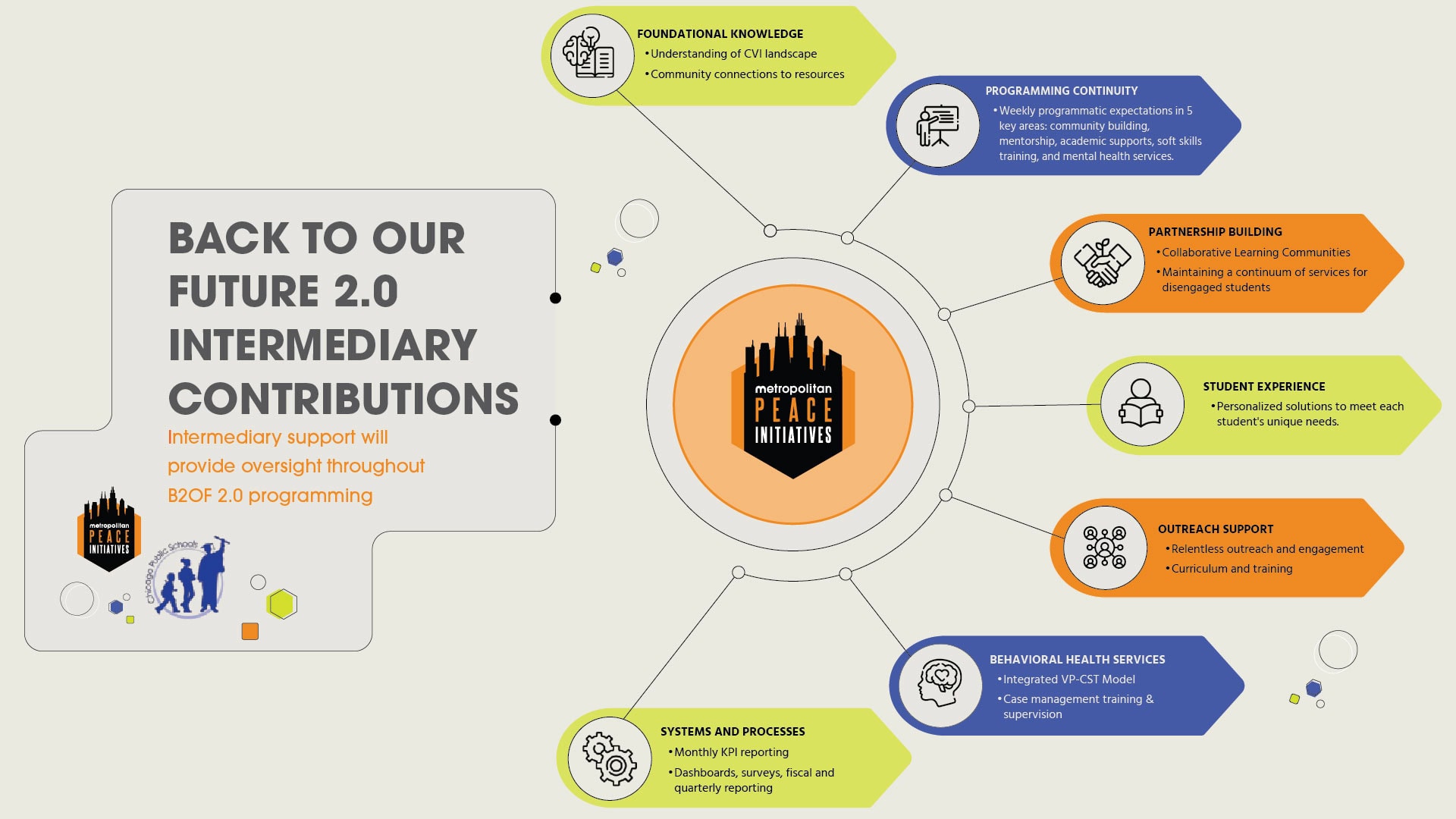
MPI will serve as the intermediary for B2OF 2.0, providing support and oversight to several CP4P organizations including Breakthrough Urban Ministries, New Life Centers, Think Outside Da Block, and UCAN. The community areas of focus include a select number of zip codes (60621, 60623, 60624, and 60644) within the Austin, Englewood, Garfield Park, Lawndale, and Little Village neighborhoods.
The pilot program concluded in 2024, with experts finding that they had “successfully identified eligible youth but saw low rates of youth participation levels in services, particularly in academic and mental health programming.”
This time around, MPI is ensuring that all participants have an Individualized Learning Plan, or ILP, and that there is continued collaboration between CPS, the City of Chicago, and community organizations. Ndebele and her team are well aware of the challenges and are focused on serving a smaller, more targeted number of participants.
“We have updated the model and supports for our partners, informed by the learnings from the first iteration,” Ndebele said. “We are confident that the 2.0 version will be more effective by equipping students with the resources they need to complete secondary education and thrive in society thereafter. We will also build a learning community amongst our providers to ensure they are sharing and deploying practices that are successful.”
The progress of B2OF 2.0 will be tracked monthly in a data management system in the areas of: program participant intake, case management, referral and program completion; community engagement activity; student re-engagement; violence reduction correlation; program completion rate; youth executive function; and satisfaction rate among youth and community organizations.

However, the true success of the program won’t be found in any data management system. Dr. Bianca Clark, MPI’s Director of Youth Interventions, believes the real impact is in the lives that will be forever changed.
“Effectiveness for us isn’t just about re-enrollment or employment numbers—though we track those closely,” says Dr. Clark. “Success looks like a young person trusting an adult again. It looks like showing up for a mentoring session, staying in the program, reimagining what their future could be.
“We’re building a model where behavioral health, mentorship, workforce access, and healing are all interconnected—and that’s how we’ll measure our impact: by how whole we help them become.”
Dr. Clark provides strategy and stewardship to the program, but also brings her deep passion for uplifting the youth. She said it’s her mission to center their voices, honor their lived experiences, and show that they are worthy of investment.
“Back to our Future 2.0 is more than a program—it’s a commitment. A commitment to re-engage young people who’ve been pushed out, left behind, or counted out, and to meet them with the supports, relationships, and healing they’ve always deserved,” Dr. Clark said.
“My role is to make sure the door doesn’t just open—but that it stays open, and that what’s on the other side is worthy of their brilliance.”
Learn more about Youth Interventions and Back to Our Future 2.0 here.