Advocates Discuss Innovative Solutions to Domestic and Community Violence in Panel Discussion Hosted by Michael Reese Health Trust
October marks Domestic Violence Awareness Month, a time of heightened attention to the experiences and needs of survivors of interpersonal violence. For Community Violence Intervention (CVI) organizations like Metropolitan Peace Initiatives (MPI), it’s also a time to reflect on the intersection between domestic and community violence, and mobilize to end both through innovative, collaborative solutions.
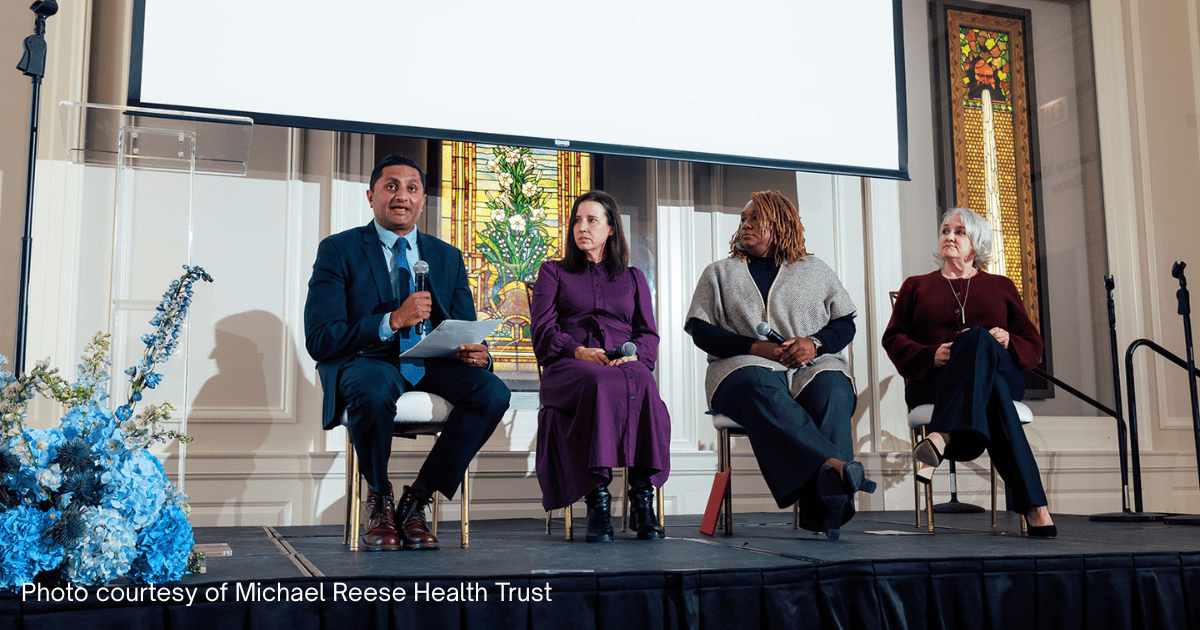
On Thursday, October 16, 2025, MPI Chief Program Officer Domonique McCord joined other experts in the field for a panel discussion titled “Breaking the Cycle of Violence: Risk, Innovation, and Root Causes,” hosted by the Michael Reese Health Trust. Moderated by the organization’s President and CEO Ameya Pawar, McCord was joined by Michael Reese Senior Program Director Jennifer Rosenkranz and The Network President and CEO Amanda Pyron, who was also presented with this year’s John F. Benjamin Exceptional Service Award.
Michael Reese, The Network, and Communities Partnering 4 Peace (or CP4P, which is convened by MPI) collaborate on an initiative called “The Intersections Project,” a coalition of community organizations and funders working in CVI and Domestic Violence Intervention (DVI) to create solutions to violence through cross-training.
McCord illustrated the ties between DVI and CVI. She, along with Rosenkranz, is an appointee to the City of Chicago’s Gender-based Violence Task Force.
“Conceptually, they’re in separate lanes, but in the real world, there are root causes that intersect. When we think about the root causes of domestic violence and community violence, we think about generational trauma,” McCord said. “We think about economic deprivation in communities that plague the individuals on both sides [of a conflict].
“So we have to focus on how we train our staff and address the root causes in a combined and intentional way.”
This partnership between Michael Reese, The Network, and CP4P has ensured that DVI and CVI staff are sufficiently cross-trained in both issues, which has become critical to reducing violence overall. In addition, the Metropolitan Peace Academy includes training on domestic and sexual violence for case managers, victim advocates, and outreach professionals.
These collaborations ensure that when outreach workers from CP4P respond to incidents of domestic violence, victims are routed to the right services, like The Network’s domestic violence hotline or restorative justice programs. This also creates a safer community overall, where solutions to violence are not punitive, but healing-centered, restorative, and sustainable. “We’re able to intervene and send someone not just to a domestic violence shelter, but a shelter that we’re aware of, because of our work with The Network. So the link there is invaluable,” McCord explained.
But at the core of the discussion was a concern for both victims of violence and those who cause harm. Restorative justice, the practice of creating non-punitive solutions to conflict, became the compass to reducing violence.
Rosencranz said, “Michael Reese has been funding domestic violence since our very first grant cycle, and for many years that work was focused on supporting survivor services […] but we also feel like it is important to support the people who cause harm. We really came to believe that we will never end domestic violence… unless we stop the people who are doing it.”
She continued, “Survivor services and services for people who come to harm want the same thing.” And what they want often reflects the very societal issues that drive violence in the first place; they want housing, employment, safety, and stability. This also means that people with lived experience, both victims and perpetrators of harm, have crucial insight into the solutions to violence.
Those solutions include The Network’s Illinois domestic violence hotline, which received nearly 60,000 contacts in 2024 from 96 out of 102 Illinois counties. The hotline ensures people experiencing a crisis can connect to life-saving resources, like transportation and emergency housing, within minutes. The Network also offers cash assistance directly through their Survivors Fund, which distributed $5 million in 2024.
Another solution mentioned during the discussion was the Peace Within Chicago Homes Program, facilitated by Metropolitan Family Services (MFS), which provides support and case management focused on creating safe relationships for people at risk of causing harm.
Pyron added, “We know that cycles of violence are deeply rooted, and part of our work in this space has to be tackling this problem in new, bold, innovative ways. That means breaking down silos and forging new connections. That’s what drives The Network’s work at the intersection of community violence intervention and domestic violence intervention.”